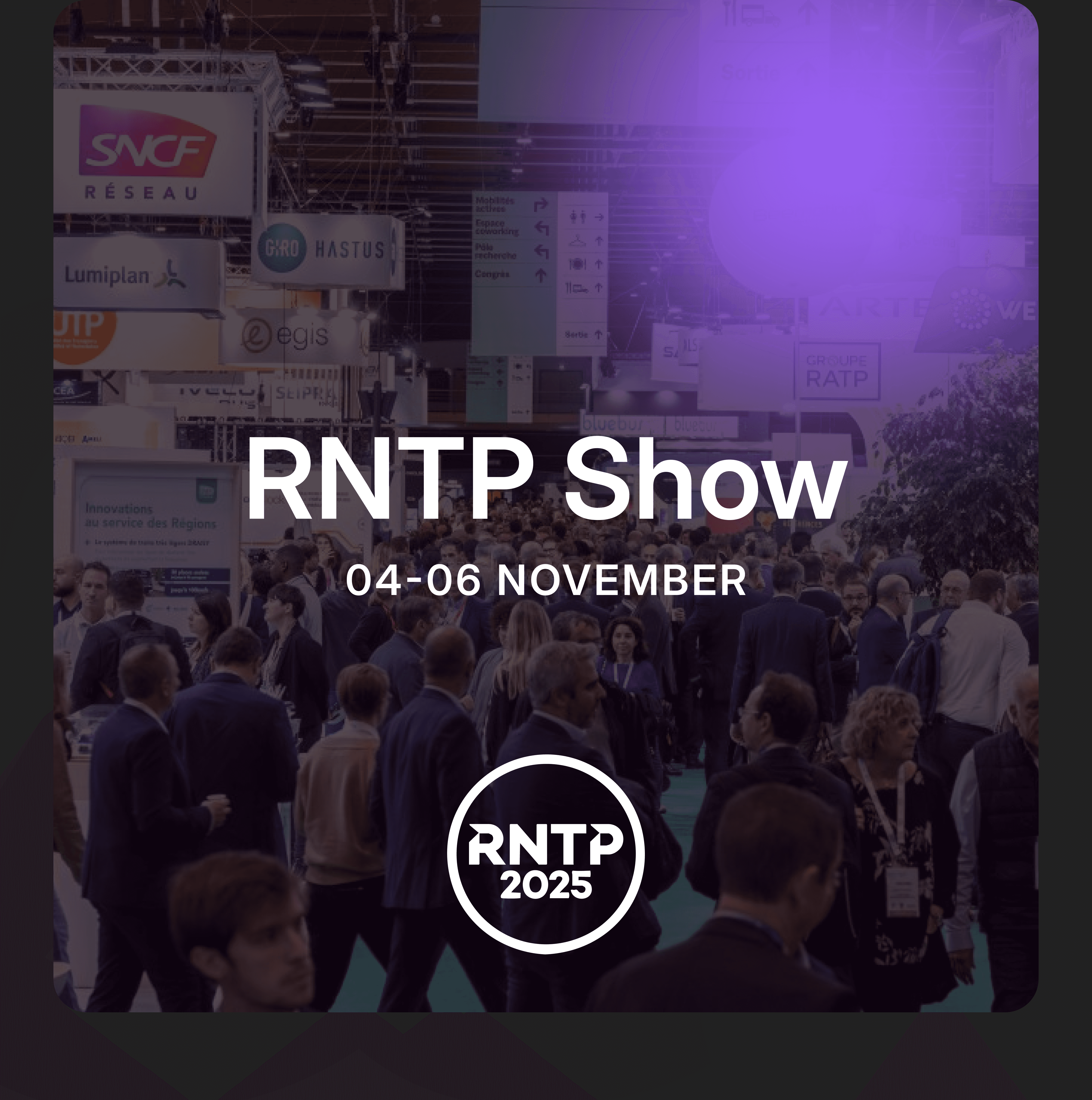
RNTP 2025: Conversational AI, MaaS, decarbonization

The strong signals of a sector in transformation before the MOB'CO

Marketing Manager @BeTomorrow

Ally Mobility at RNTP 2025

Introduction

The National Public Transport Meetings (RNTP) 2025, organized from November 4 to 6 in Orléans, gathered more than 8,000 participants and 230 exhibitors, again confirming their role as a major gathering for the sector.

With five months to go before the municipal elections, this edition — themed: “Municipal 2026: better connecting territories” — allowed for an assessment of the progress of an industry in full transformation: decarbonization, territorial governance, digital innovation, and more than ever, artificial intelligence in the service of mobility.

Three days of structured exchanges for an industry seeking coherence

The first day was marked by the inaugural conference, attended by Philippe Tabarot, Louis Nègre, and Thierry Mallet. The approach combined political vision, on-the-ground issues, and foresight.
A crossed perspective between Thierry Pech (Terra Nova) and Blanche Leridon (Institut Montaigne) enriched the discussion on territorial cohesion — a central issue for the upcoming municipal elections.

The afternoon was marked by several highlights:

  • a roundtable on quality of life at work in public transport,

  • a session dedicated to infrastructure works,

  • a press conference focused on the strategic role of freight rail — reminding of the need to rebalance flows and strengthen rail competitiveness.

The second day delved into several key themes:

  • funding for public transport and the sustainability of investments,

  • adapting offers to the needs of seniors, a major demographic challenge,

  • opening up to rail competition,

  • safety in transportation,

  • territorial cohesion,

  • digital tools facilitating access to services.

The exchanges brought together experts from GART, UTPF, France Silver Eco, and the Court of Auditors.

Finally, the third day highlighted two sensitive topics:

  • the urgency of insurance, in a context of dwindling offers and increasing risks,

  • cohabitation in public space, an increasingly pressing issue between public transport, active mobility, and cars.

Safety and respect: a national campaign against incivilities

In a climate marked by an increase in attacks against transport agents, the UTPF, Klesia, and the OPCO Mobilités presented a large national campaign, relayed by 45 networks.
It has been deployed:

  • on social media,

  • in train stations and subways,

  • on the back of buses in five major cities.

A guide to good practices has been unveiled to assist networks in preventing and managing these situations — proof that safety remains a fundamental issue for public service.

The rise of MaaS: interoperability, AI, and data sovereignty

Beyond infrastructure, the RNTP 2025 has confirmed a strong trend: MaaS is no longer a project but a strategic digital infrastructure for territories.

Level 3 MaaS — integrating multimodal route calculation, ticket purchasing, third-party services, and real-time orchestration — is becoming a standard expected by travelers and elected officials.
The API-first interoperability is essential, just like the need for platforms capable of:

  • aggregating heterogeneous data,

  • managing peak loads,

  • offering reliable transactional services,

  • providing unified resource management.

The issues discussed in the round tables (seniors, territorial cohesion, digital tools for mobility access) have shown that MaaS is not just a technical tool:

it is a lever for social inclusion, a tool for territorial coherence, and a means of digital sovereignty.

In this context, certain platforms presented by various stakeholders have sparked great curiosity, including those developed by BeTomorrow, particularly:

  • TBM Mobilités in Bordeaux, with over 212 million monthly API requests,

  • Ilevia in Lille, whose progressive deployment includes real-time data, a mobile application, bikes, parking, and contextualized services.

The notable visit of Philippe Tabarot, Minister of Transport at the stand, clearly interested in these integrated approaches, illustrated the strategic importance of MaaS in future public policies.

Beyond infrastructure, the RNTP 2025 has confirmed a strong trend: MaaS is no longer a project but a strategic digital infrastructure for territories.

Level 3 MaaS — integrating multimodal route calculation, ticket purchasing, third-party services, and real-time orchestration — is becoming a standard expected by travelers and elected officials.
The API-first interoperability is essential, just like the need for platforms capable of:

  • aggregating heterogeneous data,

  • managing peak loads,

  • offering reliable transactional services,

  • providing unified resource management.

The issues discussed in the round tables (seniors, territorial cohesion, digital tools for mobility access) have shown that MaaS is not just a technical tool:

it is a lever for social inclusion, a tool for territorial coherence, and a means of digital sovereignty.

In this context, certain platforms presented by various stakeholders have sparked great curiosity, including those developed by BeTomorrow, particularly:

  • TBM Mobilités in Bordeaux, with over 212 million monthly API requests,

  • Ilevia in Lille, whose progressive deployment includes real-time data, a mobile application, bikes, parking, and contextualized services.

The notable visit of Philippe Tabarot, Minister of Transport at the stand, clearly interested in these integrated approaches, illustrated the strategic importance of MaaS in future public policies.

Beyond infrastructure, the RNTP 2025 has confirmed a strong trend: MaaS is no longer a project but a strategic digital infrastructure for territories.

Level 3 MaaS — integrating multimodal route calculation, ticket purchasing, third-party services, and real-time orchestration — is becoming a standard expected by travelers and elected officials.
The API-first interoperability is essential, just like the need for platforms capable of:

  • aggregating heterogeneous data,

  • managing peak loads,

  • offering reliable transactional services,

  • providing unified resource management.

The issues discussed in the round tables (seniors, territorial cohesion, digital tools for mobility access) have shown that MaaS is not just a technical tool:

it is a lever for social inclusion, a tool for territorial coherence, and a means of digital sovereignty.

In this context, certain platforms presented by various stakeholders have sparked great curiosity, including those developed by BeTomorrow, particularly:

  • TBM Mobilités in Bordeaux, with over 212 million monthly API requests,

  • Ilevia in Lille, whose progressive deployment includes real-time data, a mobile application, bikes, parking, and contextualized services.

The notable visit of Philippe Tabarot, Minister of Transport at the stand, clearly interested in these integrated approaches, illustrated the strategic importance of MaaS in future public policies.

Conversational AI: a new interface for mobility

If MaaS today represents the brain of the network, conversational AI is gradually becoming its voice.

The trend was palpable in the aisles: networks are looking for solutions that can respond 24/7, across all channels, and especially in a simple and human language.

In this context, ALLY, the conversational intelligence component designed by BeTomorrow, attracted numerous discussions.
Not for its technological aspect per se, but for what it enables:

  • a more inclusive relationship,

  • a unified reading of complex systems,

  • simplified access to services.

Visitors retained a key idea:

we no longer ask the traveler to master the digital ecosystem — it’s the ecosystem that adapts to them.

Whether it's a specific route, a question about tickets, a need for accessibility, or an ongoing disruption, the information becomes intelligible and actionable.

If MaaS platforms constitute the nervous system of mobility, orchestrating all flows, conversational AI is the universal interpreter, which finally allows the network to speak the user's language. The ambition is no longer only technological: it is a cultural transformation of the travel experience.

If MaaS today represents the brain of the network, conversational AI is gradually becoming its voice.

The trend was palpable in the aisles: networks are looking for solutions that can respond 24/7, across all channels, and especially in a simple and human language.

In this context, ALLY, the conversational intelligence component designed by BeTomorrow, attracted numerous discussions.
Not for its technological aspect per se, but for what it enables:

  • a more inclusive relationship,

  • a unified reading of complex systems,

  • simplified access to services.

Visitors retained a key idea:

we no longer ask the traveler to master the digital ecosystem — it’s the ecosystem that adapts to them.

Whether it's a specific route, a question about tickets, a need for accessibility, or an ongoing disruption, the information becomes intelligible and actionable.

If MaaS platforms constitute the nervous system of mobility, orchestrating all flows, conversational AI is the universal interpreter, which finally allows the network to speak the user's language. The ambition is no longer only technological: it is a cultural transformation of the travel experience.

If MaaS today represents the brain of the network, conversational AI is gradually becoming its voice.

The trend was palpable in the aisles: networks are looking for solutions that can respond 24/7, across all channels, and especially in a simple and human language.

In this context, ALLY, the conversational intelligence component designed by BeTomorrow, attracted numerous discussions.
Not for its technological aspect per se, but for what it enables:

  • a more inclusive relationship,

  • a unified reading of complex systems,

  • simplified access to services.

Visitors retained a key idea:

we no longer ask the traveler to master the digital ecosystem — it’s the ecosystem that adapts to them.

Whether it's a specific route, a question about tickets, a need for accessibility, or an ongoing disruption, the information becomes intelligible and actionable.

If MaaS platforms constitute the nervous system of mobility, orchestrating all flows, conversational AI is the universal interpreter, which finally allows the network to speak the user's language. The ambition is no longer only technological: it is a cultural transformation of the travel experience.

2026: governance, skills, territorial cohesion

As the municipal elections approach, the GART is preparing a Mobility & Municipal Tools 2026 toolbox, aimed at informing future local programs:

  • simplification of access to services,

  • sustainable financing,

  • road sharing,

  • connection of peri-urban and rural territories.

The issue of competencies is also critical: the UTPF estimates the need for 100,000 recruits by 2030.

Two initiatives marked the exhibition:

  • the Immersive Tent “Jobs on Stage”,

  • the Mobility Café, a true incubator of ideas bringing together students and professionals.

As the municipal elections approach, the GART is preparing a Mobility & Municipal Tools 2026 toolbox, aimed at informing future local programs:

  • simplification of access to services,

  • sustainable financing,

  • road sharing,

  • connection of peri-urban and rural territories.

The issue of competencies is also critical: the UTPF estimates the need for 100,000 recruits by 2030.

Two initiatives marked the exhibition:

  • the Immersive Tent “Jobs on Stage”,

  • the Mobility Café, a true incubator of ideas bringing together students and professionals.

As the municipal elections approach, the GART is preparing a Mobility & Municipal Tools 2026 toolbox, aimed at informing future local programs:

  • simplification of access to services,

  • sustainable financing,

  • road sharing,

  • connection of peri-urban and rural territories.

The issue of competencies is also critical: the UTPF estimates the need for 100,000 recruits by 2030.

Two initiatives marked the exhibition:

  • the Immersive Tent “Jobs on Stage”,

  • the Mobility Café, a true incubator of ideas bringing together students and professionals.

Last edited under this name: welcome to MOB'CO

2025 marks indeed the last year of the RNTP.
From 2026, the event merges with EuMo Expo (European Mobility Expo) to become MOB’CO, a new event dedicated to sustainable mobility, organized by the GART and the UTPF.
Meet from June 9 to 11, 2026, at Paris Porte de Versailles for the first edition!

2025 marks indeed the last year of the RNTP.
From 2026, the event merges with EuMo Expo (European Mobility Expo) to become MOB’CO, a new event dedicated to sustainable mobility, organized by the GART and the UTPF.
Meet from June 9 to 11, 2026, at Paris Porte de Versailles for the first edition!

2025 marks indeed the last year of the RNTP.
From 2026, the event merges with EuMo Expo (European Mobility Expo) to become MOB’CO, a new event dedicated to sustainable mobility, organized by the GART and the UTPF.
Meet from June 9 to 11, 2026, at Paris Porte de Versailles for the first edition!